
A change of use is the official procedure by which the existing use of a building, or part of it, is replaced with a new one. In Slovenia it is governed by the Construction Act (GZ-1) and the Spatial Planning Act (ZUreP-3). The use of a property is not merely an administrative category: it is defined by the entry in the land register, the cadastre and the municipal spatial plan, and it is precisely that entry which determines whether you can legally lease, sell, or obtain financing against the property.
Without a properly completed change of use, business premises remain an apartment on paper, and agricultural land does not become a warehouse. The consequences are concrete: the bank refuses financing, the buyer withdraws from the contract, the inspector issues a ruling. The procedure is not fast, but it is predictable if you know what lies ahead.
Typical examples of a change of use include:
- an apartment converted into an office, or vice versa,
- a garage or basement turned into business premises,
- an agricultural building converted into tourist accommodation,
- a warehouse converted into a restaurant or bar.
Table of Contents
- What legal conditions must be met before a change of use?
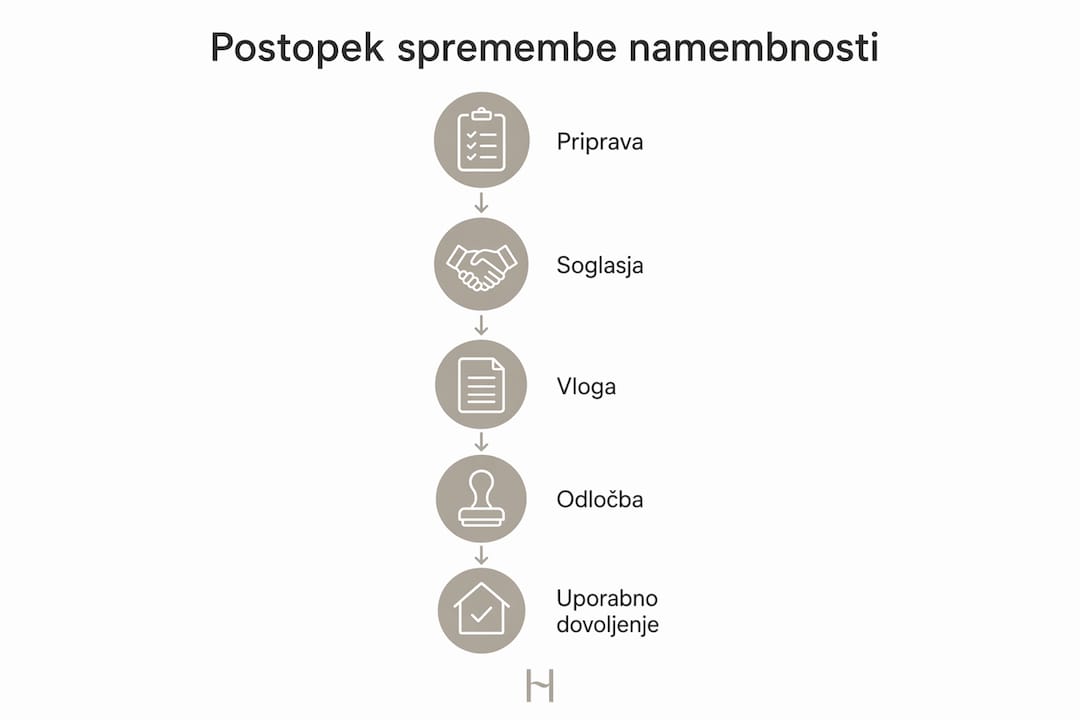
- How does the change-of-use procedure work step by step?
- What documentation is required for a successful change of use?
- What are the most common mistakes and pitfalls in changing use?
- How much does a change of use cost and what affects property value?
- What do experts recommend for a successful change of use in Slovenia?
- HOOF: expert support for changing the use of business premises
- Key takeaways
What legal conditions must be met before a change of use?
The legal basis for a change of use in Slovenia rests on two pillars: spatial planning legislation and construction legislation. Both must be satisfied at the same time.
Spatial planning acts determine which use is permitted at all in a given area. The designated use of space is set by municipal spatial plans (OPN) and municipal detailed spatial plans (OPPN). Before planning anything, check whether your municipality even allows the new use at that location.
The key legal conditions are:
- Compliance with the OPN or OPPN: the new use must comply with the permitted uses set out in the municipality's spatial planning act, including parking standards and other spatial requirements.
- Building permit: often mandatory, especially where the change involves reconstruction or an extension. Exemptions exist for non-demanding structures and certain classes of buildings.
- Legality of the existing building: the administrative authority will check whether the building has a valid building permit or has been legalized. Without this, a change of use is not possible.
- Essential requirements of the building: the new use must not compromise fire safety, structural stability, health requirements, or energy efficiency.
Experts emphasize that aligning the procedure with spatial planning acts and demonstrating the impact of the intervention on the surroundings and the safety of the building is a condition without which the administrative authority will not approve the application. Incomplete documentation on impacts is one of the most common reasons for rejection.
How does the change-of-use procedure work step by step?
The procedure is not linear in the sense that each step automatically follows the previous one. Delays occur where investors least expect them: in obtaining consent from co-owners and in acquiring project documentation.
- Checking spatial planning conditions with the municipality or through the eProstor portal.
- Commissioning project documentation from a licensed architect or designer.
- Obtaining consents from co-owners (in multi-unit buildings) and any consents from infrastructure operators.
- Filing an application for a building permit with the competent administrative unit.
- Administrative procedure: the authority checks the legality of the building, compliance with spatial planning acts, and the completeness of the documentation.
- Obtaining the building permit and carrying out the works (if required).
- Obtaining the occupancy permit upon completion of the works.
| Phase | Approximate timeframe |
|---|---|
| Preparation of project documentation | a few weeks to several months |
| Obtaining co-owner consents | a few weeks to a few months |
| Administrative procedure (building permit) | a few weeks to a few months |
| Carrying out the works (if required) | depends on scope |
| Obtaining the occupancy permit | a few weeks to several weeks |
The entire process, from the first consultation to a final and binding occupancy permit, takes several months in practice, depending on the complexity of the intervention and the responsiveness of the municipality.

What documentation is required for a successful change of use?
Documentation is where most applications fail. An incomplete application means the procedure is extended by weeks or months.
Mandatory documents for a building permit application:
- Project documentation with a detailed description of the intervention, technical characteristics, and impact on the surroundings.
- Proof of the legality of the existing building (final building permit, legalization, or occupancy permit).
- Consents from co-owners, where a multi-unit building or a change to common areas is involved.
- Confirmation of payment of the municipal infrastructure contribution, if required under ZUreP-3.
- Supervisor's statement on the compliance of the completed works with regulations (for obtaining the occupancy permit).
| Document | When it is required |
|---|---|
| Project documentation | Always |
| Proof of the legality of the building | Always |
| Co-owner consent | Multi-unit buildings |
| Confirmation of the municipal infrastructure contribution | When required under ZUreP-3 |
| Supervisor's statement | Upon obtaining the occupancy permit |
For a minor reconstruction with no intervention into common areas, the documentation is more modest. For an extension, or a change that affects structural stability, comprehensive project documentation with all supporting studies is required.
What are the most common mistakes and pitfalls in changing use?
Most complications are not the result of ill will on the part of administrative authorities, but of mistakes that could easily be avoided with a little planning.
- Ignoring the spatial planning act: investors often assume the new use is permitted without checking the OPN. The result is an application rejected already at the review stage.
- Neglecting co-owner consents: consent from co-owners is often required in multi-unit buildings, yet investors overlook it or underestimate the time it takes to obtain.
- An unlawful building: if the building does not have a properly issued building permit or legalization, a change of use is not possible. The legality of the building must be resolved first.
- Incomplete project documentation: missing studies, incomplete descriptions of the intervention, or incorrectly defined impacts on the surroundings are the most common reason for delays in the procedure.
- A forgotten occupancy permit: some investors, after obtaining the building permit and completing the works, forget to file an application for an occupancy permit. Without it, the change of use is not legally valid.
- Mistakes in legal procedures: for more complex cases, it is also worth checking common legal mistakes that investors make in real estate transactions.
Expert tip: Before filing an application, arrange a preliminary consultation with a licensed architect and check the spatial planning conditions with the municipality. An hour of consultation before filing saves weeks of waiting afterward.

How much does a change of use cost and what affects property value?
The costs of the procedure consist of several items, which vary depending on the scope of the intervention and the requirements of the municipality.
- Administrative fees: dependent on the type of procedure and the value of the investment.
- Project documentation: the cost varies according to the scope and complexity of the intervention; this is often the largest item.
- Municipal infrastructure contribution: required under ZUreP-3 when the change of use increases the burden on municipal infrastructure. The amount depends on the municipality and the type of intervention.
- Supervisor's fees: mandatory when obtaining the occupancy permit.
- Unforeseen costs: delays in obtaining consents, additional studies, legalization of the building.
The costs of the change-of-use procedure include administrative fees, project documentation, and the municipal infrastructure contribution, with the total amount not being uniform and depending on the scope of the intervention and the requirements of the individual municipality.
A change of use often increases the market value of a property, particularly when converting residential space into business premises or when obtaining a tourism-related use. The tax implications are equally real: a change of use can affect the assessment of real estate tax and the tax base on a subsequent sale. A closer look at property valuation shows that a correctly recorded use is one of the key factors in assessing market value.
What do experts recommend for a successful change of use in Slovenia?
Experienced consultants and architects working in the Slovenian real estate market highlight three points that separate successful procedures from those that drag on.
The first is early verification of the legality of the building. Before doing anything else, check whether your building has properly arranged documentation. The administrative authority will check this itself, but it is better if you discover any problems yourself, rather than the authority discovering them midway through the procedure.
The second is alignment with the municipal spatial planning act. A spatial planning act is not a mere formality. It determines what is even possible on your parcel, and no project documentation can change that. Check the OPN or OPPN with the municipality before commissioning a designer.
The third is obtaining the occupancy permit. This is the step investors most often skip or postpone. The occupancy permit confirms that the works were carried out in accordance with regulations and that the building meets the essential requirements for the new use. Without it, the change is not on record, and the property cannot be legally leased or sold in its new capacity.
A change of use without a final and binding occupancy permit is, from the perspective of the records, the same as if it had never happened at all. Every step of the procedure must be completed to the end, not merely started.
Expert tip: For more complex cases, such as changes of use in multi-unit buildings or agricultural structures, it is worth engaging a consultant who is familiar with both spatial planning legislation and the local particularities of your municipality. Saving on the fee often means doubling the time the procedure takes.
Investors considering a change of use as part of a broader investment strategy will find useful guidance in advice for investors in commercial real estate.
HOOF: expert support for changing the use of business premises
Once the change-of-use procedure is complete, the next question arises: what to do with the new space so that it delivers real value.

HOOF is a commercial real estate agency that supports owners and investors throughout the entire process, from analyzing the market potential of the new use to finding tenants and structuring lease arrangements. Our advantage is not just market knowledge, but understanding how a change of use affects the value of a property and what possibilities it opens up for leasing or sale. Owners who have completed a change of use and are looking for the right tenants for their business premises, or those considering leasing offices in Ljubljana, get concrete support from HOOF, not just general advice. Get in touch with us and let's assess together what your space can achieve on the market after a change of use.
Key takeaways
A change of use for business premises in Slovenia requires compliance with spatial planning acts, a properly established legality of the building, and obtaining both the building and occupancy permits, with every omitted step being grounds for rejection or invalidity of the procedure.
| Point | Details |
|---|---|
| Legal basis | The procedure is governed by GZ-1 and ZUreP-3; the new use must comply with the OPN or OPPN. |
| Legality of the building | Without a properly issued building permit or legalization, a change of use is not possible. |
| Key documentation | Project documentation, proof of legality, co-owner consents, and confirmation of the municipal infrastructure contribution. |
| Timeframe | The entire procedure takes several months in practice, depending on the scope of the intervention and the responsiveness of the municipality. |
| HOOF | HOOF advises owners and investors on market positioning and leasing of premises after a change of use. |