
Capital expenditure planning means deciding which large, long-lived spending a property needs, what it will really cost, in which year the cash leaves your account and who carries it. For an owner of offices, retail units or warehouses in Slovenia, a good plan starts from the building itself: its condition, its leases and its market position. That is why a plan built next to property management and valuation data holds up better than a spreadsheet of guesses, and why we at HOOF build our property management and investment advisory work around the same facts.
This guide is for owners, investors, landlords and tenants who have to put a number on a roof, an HVAC system, a fit-out or a refurbishment and defend it.
TL;DR
- A CapEx plan covers spending that creates or extends the life of a long-term asset. Routine repairs and running costs are operating expenses.
- Build the project list from building condition data, equipment age, regulatory duties, tenant needs and deferred maintenance, then cost each item in today's money and escalate it to the year you will pay.
- Rank projects by consequence of failure and time to failure, not by price alone.
- Forecast the cash month by month and check it against the leases: under a gross or net lease, who pays decides whether the cost is yours at all.
- In Slovenia, tax depreciation is capped at 3% a year for buildings and 20% for equipment, and land is never depreciated.
Table of Contents
- What belongs in a capital plan
- Build the project list from the building, not from memory
- Estimate costs the way the project will actually spend them
- Rank projects so the cash goes where the risk is
- Calculate CapEx and forecast the cash
- Slovenian tax and accounting points to build in
- Approve, monitor and update the plan
- Why valuation and market data belong in the plan
- Put the plan next to a property manager
- FAQ
- Sources
What belongs in a capital plan
One CapEx planning guide describes the process as identifying, evaluating, approving and monitoring investments in long-term assets. For a property, that typically means a new roof, a façade, lifts, heating and cooling plant, fit-out for a new tenant, or a change of layout. Routine repairs, subscriptions, salaries and utilities are operating expenses unless they meet your capitalization criteria.
The same guide gives a practical test. An item belongs in the plan when it:
- creates or acquires a long-term asset, or extends an existing asset's capacity or useful life;
- meets your capitalization policy and threshold;
- includes directly attributable costs such as freight, installation and site preparation;
- can be tracked over its useful life with an owner, an in-service date and a depreciation method.
The last point matters more than it looks. A plan that nobody owns is a wish list. Give every line a named person, a date and a depreciation method before the plan goes to a partner, a bank or the board.
CapEx or operating expense: a quick property example
Replacing a few failed ceiling tiles is maintenance. Replacing the whole HVAC system in an office building extends the asset's life and capacity, so it is capital. Repainting a unit between tenants is normally an expense. Reconfiguring the same unit into two smaller ones for new tenants is capital. Where the line sits for your accounts depends on your capitalization policy, so agree it with your accountant before you build the list.
Build the project list from the building, not from memory
The most common planning mistake is starting from the budget instead of the asset. A five-year capital plan guide suggests compiling the full universe of projects from:
- building condition assessments and reserve study projections;
- equipment age and replacement schedules;
- regulatory requirements;
- tenant improvement needs;
- strategic repositioning plans and energy initiatives;
- the backlog of deferred maintenance.
For each project, record the property, the system affected, its condition rating, the estimated cost in current prices, the urgency, dependencies and the business case.
Check the data before you trust it
One capital planning framework warns that cost figures in a condition assessment are order-of-magnitude estimates, not contractor bids. Assessments older than two or three years should have their costs indexed forward. Scope assumptions need checking too: an HVAC replacement may bring asbestos removal or code upgrades with it. And confirm that the assessment covered every occupied space.
Another practical framework separates the cost of a need from the cost of the project. A deficiency costed as quantity times unit cost will understate the real outlay once you add design, construction management, contingency, soft costs and escalation.
Use your leases as a data source
For a landlord, the lease file is part of the asset register. Two documents change what lands in your plan:
- A schedule of condition records the state of the premises at handover, which tells you what you owe at the start and what a tenant owes at the end.
- The lease type decides who funds what. Our guide to gross and net leases in Slovenia shows how costs are split, and that split determines which items in your plan are yours and which can be passed on.
If you are a tenant planning a fit-out, the same logic applies in reverse: check which works the lease puts on you before you commit budget to them.
Estimate costs the way the project will actually spend them
Know how accurate your estimate is
In Slovenia, the Chamber of Engineers' construction documentation rules set the expected accuracy of an investment estimate by design phase. It is plus or minus 25% at the pre-investment design stage, 15% at the design project stage and 5% at the execution design stage, based on comparable buildings and measurable quantities. In practice, an early figure for a refurbishment can be a quarter off in either direction. Put that range into the plan instead of a single number, and tighten it as design progresses.
The Slovenian government's guidelines for procuring architectural and engineering services recommend the SIST DIN 276-1 standard for estimating building construction costs. They also note that financial institutions often require an investment programme and an independent expert review before they approve financing. If a bank will be involved, plan for that documentation from the start.
Escalate and add contingency
A cost quoted in today's prices is not the cost in year three. The five-year capital plan guide cited above recommends escalation of typically 3 to 5% a year, and contingencies of 10 to 15% for year one, 15 to 20% for years two and three, and 20 to 30% for years four and five. These are planning assumptions from one guide, not Slovenian rules, so adjust them to your own contractor prices.
A worked example, with illustrative figures: a roof renovation is estimated at €100,000 in current prices and is planned for year three. At 4% annual escalation it becomes about €112,500. Adding a 15 to 20% contingency gives roughly €129,400 to €135,000. That is the figure for the plan, not the €100,000 on the quote.
Rank projects so the cash goes where the risk is
You will rarely fund everything in one year. The CapEx guide cited earlier proposes four tiers: fund first what is mandatory for compliance or safety, fund within capacity the maintenance with a high risk of failure, rank growth projects by value once they clear your return hurdle, and defer or redesign anything with weak assumptions or insufficient cash.
To rank inside those tiers, the facility condition framework uses two questions for every deficiency: what is the consequence of failure (business interruption, life safety, regulatory non-compliance, lease default), and how soon could it fail? That gives four groups:
| Consequence of failure | Time to failure | Treat it as |
|---|---|---|
| High | Short | Immediate capital need |
| High | Longer | Priority capital reserve |
| Low | Short | Operational maintenance |
| Low | Long | Watch list |
Price alone is a poor sorting tool. A cheap part that is likely to fail can carry more risk than an expensive system that will run for years. For a landlord, "lease default" is the consequence that is easy to overlook: a failed lift or heating system in a let building can put rent and the tenant relationship at risk at once.
For growth projects, such as converting space or repositioning a building, test the case with several measures (NPV, IRR, payback, ROI) rather than one. If you want an outside view of whether a repositioning will pay back, our investment advisory work covers that question for commercial property in Slovenia.
Calculate CapEx and forecast the cash
The standard accounting formula is ending net PP&E (property, plant and equipment) minus beginning net PP&E plus depreciation expense. The same guide gives an example: €2,750,000 minus €2,400,000 plus €300,000 gives €650,000 of CapEx for the year. Reconcile the result with the cash flow statement and the fixed-asset register.
That formula looks backwards at what you spent. A plan looks forward, and three habits make the forecast useful:
- Map each item to the month the cash leaves. A project that starts in October and runs six months hits several months, not one.
- Model the financed cash flow. If a lender funds part of the project, the plan should show your deposit and the loan drawdowns, not just the asset cost.
- Watch overlaps. A CapEx forecasting guide points out that overlapping build windows can push a monthly budget envelope negative even when the annual total fits.
CapEx also reaches the accounts at different times. The asset sits on the balance sheet, depreciation runs through the income statement over the useful life, and the cash shows as an investing outflow. That gap is why a profitable refurbishment can still strain liquidity in the year you pay for it.
Slovenian tax and accounting points to build in
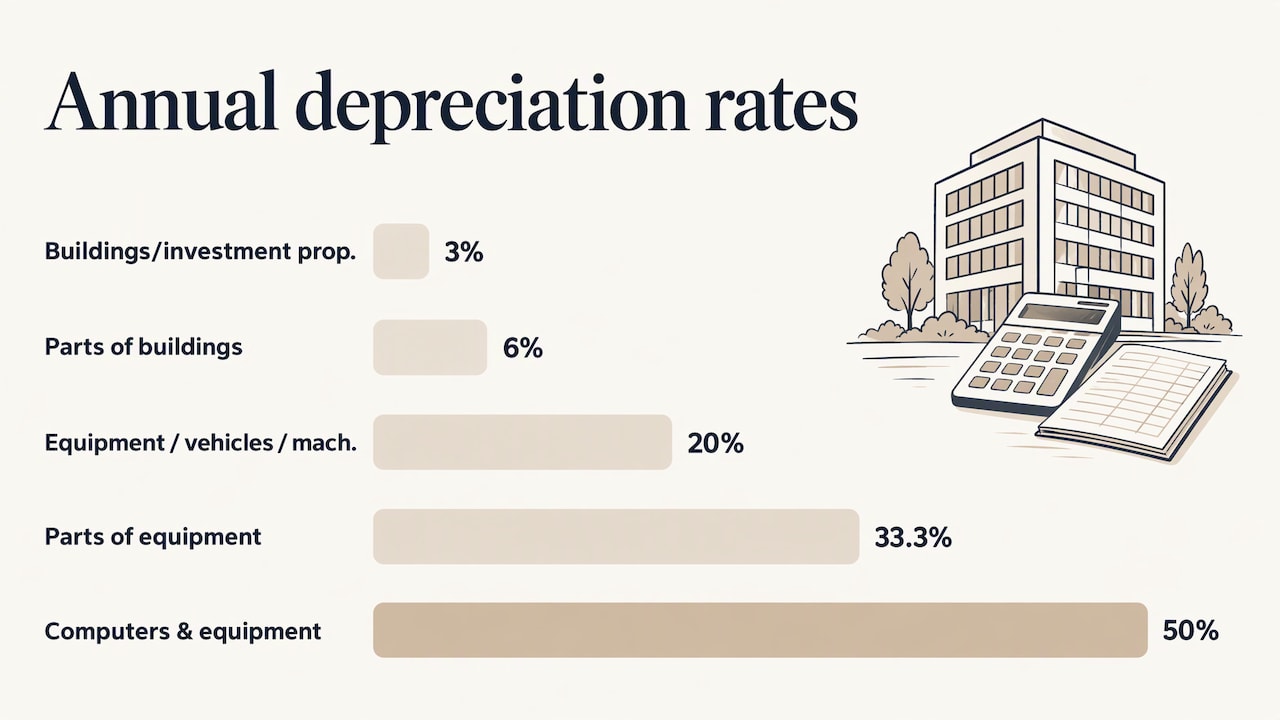
The tax treatment shapes the plan's after-tax cost. The Ministry of Finance's Taxation in Slovenia guide (2018 edition) states that tax-recognized depreciation cannot exceed straight-line depreciation at maximum annual rates:
| Asset | Maximum annual rate |
|---|---|
| Buildings, including investment property | 3% |
| Parts of buildings | 6% |
| Equipment, vehicles, machinery | 20% |
| Parts of equipment | 33.3% |
| Computers and computer equipment | 50% |
For an office building bought or built for €1,000,000 (excluding land), the cap is €30,000 of tax depreciation a year. Land is never depreciated, according to a Slovenian accounting guide for sole traders, which also explains that the purchase of a fixed asset is an increase in assets rather than an expense, and that acquisition cost includes dependent costs such as installation and transport. Separate land from building value early, because the split drives how much of the price you can ever depreciate.
There is also a 40% investment tax relief for equipment and intangible assets, but not for buildings, and the corporate income tax guide notes it is clawed back if the asset is disposed of within three years. Tax rules change and these figures come from guides dated 2018 and 2021, so confirm the current rates with your accountant or the Financial Administration (FURS) before you finalize the plan.
Two more Slovenian details matter if you plan with borrowed money. The Slovenian Entrepreneurship Fund's P1 plus guarantee scheme counts land purchase, construction, renovation or purchase of business property as eligible costs. Costs are net of VAT for VAT-registered businesses and gross for those that are not. And if you let property, check how VAT applies to your rents in our guide to VAT on commercial leases in Slovenia, because it changes whether the VAT on your capital works is recoverable.
Approve, monitor and update the plan
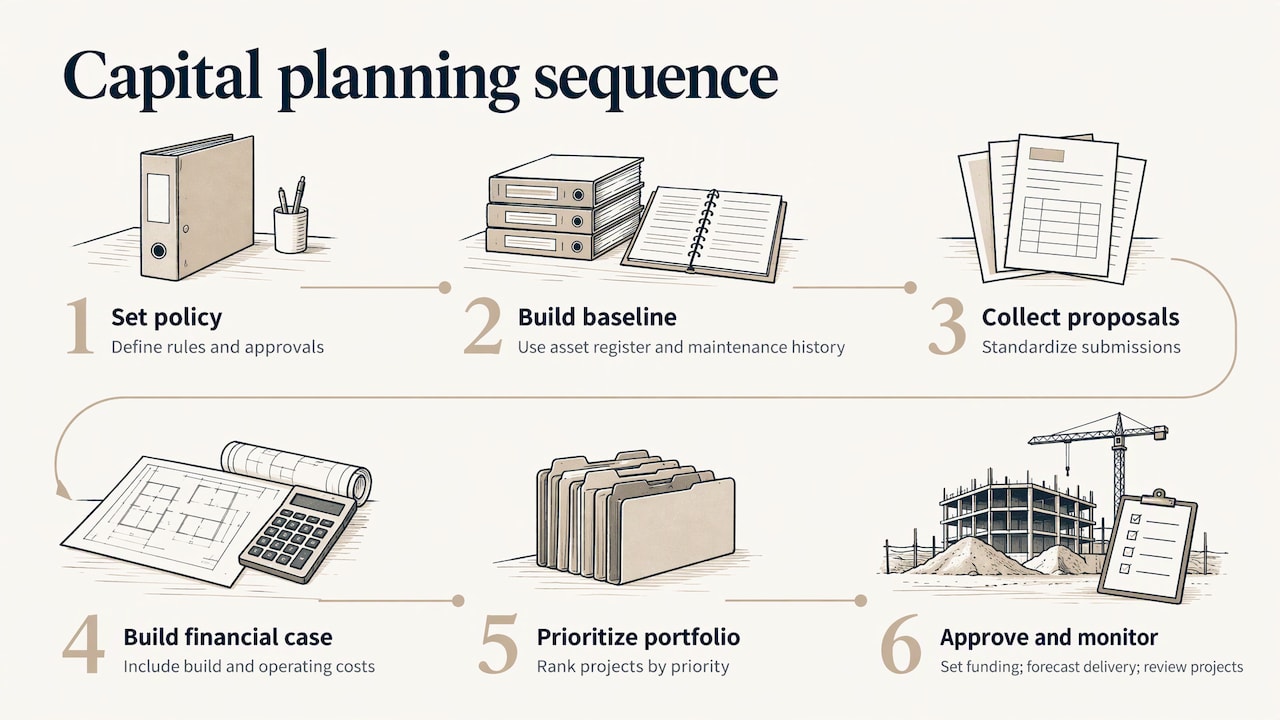
The seven-step process in the CapEx guide cited above is a good skeleton: set policy and approval rules; build the asset baseline from the fixed-asset register and maintenance history; collect standardized proposals; build the financial case; prioritize the portfolio; approve funding with an authorized amount, funding source, payment schedule, in-service date and contingency; then monitor delivery with a rolling forecast and a post-implementation review.
The New York State Comptroller's multiyear capital planning guide reduces a capital plan to three questions: what are the priorities, what will they cost to build and operate, and what fiscal capacity do you have over time? The guide is written for local governments in the United States, but the questions fit any owner. Note the middle one: operating cost belongs in the plan too. A new building system that is cheaper to buy but costlier to run is not cheaper.
Review the plan at least once a year. Re-index old cost estimates, move items whose condition changed, and close out finished projects by comparing actual cost with the estimate. That comparison is what makes next year's contingency percentages credible.
Why valuation and market data belong in the plan
Capital spending only makes sense against what the asset is worth and what the market will pay for it. A new lobby does not matter if the rent per square meter in your location will not rise. Our guide to valuing commercial property in Slovenia explains the methods, and the same numbers answer practical questions: does this refurbishment raise value by more than it costs, and is it worth doing before a sale or a re-letting?
Tenants face the mirror image. A company looking for premises can compare how much capital a landlord will put into a space against how much the tenant must fund, which is a conversation we handle through tenant representation.
Our view: the plan is only as good as the property data behind it
We see a capital plan as a property decision first and a finance exercise second. The spreadsheet is the easy part. The hard part is knowing the building: what the leases say, which systems are ageing, what rents the location supports and what a buyer or tenant will expect in two or three years.
That is why we work from the property outward. Property management, valuation, market analysis and investment advisory sit side by side in our service range, and we offer them with a boutique approach, personal service and long-term relationships with clients across the Slovenian and regional commercial property market. A capital plan made with all of that on the table is easier to defend to a partner, a bank or a board.
Our advice to owners is simple: do not wait for a failure to start the list. Put every system, every lease obligation and every planned repositioning in one place, rank it by risk, and revisit it every year.
Maruša
Put the plan next to a property manager
If you own commercial property in Slovenia and want the capital plan, the leases and the building to line up, our commercial property management service covers the ongoing running of your property, and our team also offers valuation, market analysis and investment advisory. You can see the full range on our commercial spaces page.

Tell us about the property, its leases and the works you expect, and we will take it from there.
FAQ
What is capital expenditure planning?
It is the process of identifying, evaluating, approving and monitoring spending on long-term assets such as buildings, equipment and major refurbishments. The result is a multi-year plan showing what you will spend, when, and how you will fund it.
Is a high CapEx good or bad?
Neither by itself. High spending can mean a growing or improving portfolio, or it can mean catch-up on neglected maintenance. Judge it against the return the projects are expected to produce and against your available cash, since CapEx reduces free cash flow in the year it is paid.
What is an example of a capital expenditure on commercial property?
Replacing a roof, installing a new heating and cooling system, building a new warehouse extension or fitting out a unit for a new tenant. Each creates or extends the life of an asset, in contrast to routine repairs, which are operating expenses.
How much should I add for contingency and inflation?
One published planning guide suggests 3 to 5% annual escalation, with contingency of 10 to 15% in year one rising to 20 to 30% by years four and five. Treat these as starting assumptions and replace them with your own contractor quotes as the design firms up.
Sources
- What Is CapEx Planning? Budgeting Guide
- How to Create a 5-Year Capital Plan
- How to Turn a Facility Condition Review Into a Capital Plan
- From Facility Condition Assessment to Capital Planning
- How to Build a CapEx Forecast
- IZS Pravila stroke 2022
- Smernice za javno naročanje arhitekturnih in inženirskih storitev
- Taxation in Slovenia
- Računovodstvo za samostojne podjetnike
- Davek od dohodkov pravnih oseb
- P1 plus 2026 guarantees
- Multiyear Capital Planning guide