
BREEAM and LEED are both respected green building certificates, and for a commercial property in Slovenia the practical difference is this: BREEAM is a British system that weighs a wide range of issues and adapts to the country, while LEED is an American points system built around energy and carbon. Which one is right depends less on which is "better" and more on who will rent or buy the building: an international tenant with a global ESG policy, a European fund, or a local company that simply wants lower running costs. This guide explains how the two work, what the ratings mean, what they cost and how to decide, so you can brief your agent, architect or investment committee with confidence.
We advise owners, investors and tenants of commercial space in Slovenia, so we look at these labels from the transaction side: do they change what a building is worth, how fast it leases and what a tenant should ask for.
TL;DR
- BREEAM (UK, 1990) scores a building across nine categories and gives a rating from Pass to Outstanding. LEED (USA, run by the USGBC) awards points and gives Certified, Silver, Gold or Platinum.
- LEED's top level is Platinum (80+ points). BREEAM's top level is Outstanding (85% or more). The scales are not interchangeable.
- BREEAM is often preferred in Europe for its flexibility. LEED tends to be requested by North American and global corporate tenants. Slovenia's flagship office example, Vilharia in Ljubljana, was pre-certified LEED Platinum.
- Fees are the small part of the bill. The building work needed to earn the rating is the real cost.
- Before choosing, check who your target tenant or buyer is, whether the building is new or existing, and what the lease or fund policy already requires.
Table of Contents
- What BREEAM and LEED are
- How the scoring and ratings differ
- Emphasis: breadth versus energy
- What each costs
- The process in practice
- What this means in Slovenia
- How to choose: five questions
- For tenants: reading a green label in a lease
- Where we help
- Our view
- FAQ
- Sources
What BREEAM and LEED are
BREEAM stands for Building Research Establishment Environmental Assessment Method. The UK's BRE developed it in 1990, and it assesses buildings across categories including energy, water, health and well-being, pollution, transport, materials, waste, land use and ecology, and management. It covers a building's life, from design and construction to operation, and supports goals such as net-zero carbon, circularity, resilience and biodiversity.
LEED stands for Leadership in Energy and Environmental Design. The U.S. Green Building Council (USGBC) runs it, and describes it as the most widely recognized green building rating system in the world. It works through credit categories covering energy and water use, materials, waste and indoor environmental quality, and it applies to new construction, interior fit-outs, operations and maintenance, and shell and core projects.
Both are voluntary, both are verified by a third party, and both exist in versions for new buildings and for buildings already in use. For a landlord or tenant, that last point matters: most commercial space in Slovenia is existing stock, so the "in use" schemes are often more relevant than the new-build ones.
How the scoring and ratings differ
BREEAM: percentage and weighted categories
BREEAM applies weightings to its issue categories, based on consultation, so that more important topics count for more. A professional comparison lists nine categories: Management, Health and Well-being, Energy, Transport, Water, Materials, Waste, Land Use and Ecology, and Pollution.
The score is a percentage, and the percentage maps to a rating. According to BREEAM's own description, ratings run Pass, Good, Very Good, Excellent and Outstanding (plus Acceptable for the In-Use scheme only), shown as stars on the certificate. A licensed assessor carries out the assessment, and BRE Global runs a quality audit on top.
Thresholds have shifted between versions. Older descriptions give Pass at 30% and Good at 45%. A 2026 academic study of the current international new construction standard (V7, issued in July 2025) reports Pass at 25% or more, Good at 40%, Very Good at 55%, Excellent at 70% and Outstanding at 85%. The same study notes that V7 adapts category weights to the country or region, which is relevant for a project in Slovenia.

LEED: credits and points
LEED is a scorecard. You complete the mandatory prerequisites, then earn points for the credits you choose. Per the USGBC, the levels are Certified at 40 to 49 points, Silver at 50 to 59, Gold at 60 to 79 and Platinum at 80 or more, with review by the Green Business Certification Inc. (GBCI).
A 2008 comparison described LEED credits as equally weighted, while BREEAM weights its categories. Older LEED versions made the effect visible: in LEED v3, Energy and Atmosphere carried 35% of the weighting, ahead of Sustainable Sites at 26%. The current LEED v5 for new construction has 49 criteria and 110 points, against 51 issues and 165 standard credits in BREEAM International New Construction V7.
The highest rating in each
The top LEED rating is Platinum, at 80 points or more. The top BREEAM rating is Outstanding, at 85% or more. Gold in LEED (60 to 79 points) and Excellent in BREEAM (70% or more) are the levels most buyers treat as "seriously green". Do not equate the two by name: a LEED Gold and a BREEAM Very Good are measured on different scales and cannot be converted exactly.
| BREEAM | LEED | |
|---|---|---|
| Origin | UK, BRE, 1990 | USA, USGBC |
| Scoring | Weighted categories, percentage score | Credits, points |
| Levels | Pass, Good, Very Good, Excellent, Outstanding | Certified, Silver, Gold, Platinum |
| Top level | Outstanding (85%+) | Platinum (80+ points) |
| Emphasis | Broad: ecology, pollution, management, health, materials | Energy, carbon, water, indoor quality |
| Existing buildings | BREEAM In-Use | LEED O+M |
| Typical demand | Europe, UK-linked investors | North American and global corporate tenants |
Emphasis: breadth versus energy
A 2024 overview says BREEAM covers a broader range of categories, such as ecology and pollution, than LEED, which concentrates on energy efficiency and carbon reduction. A 2025 review of more than 50 peer-reviewed articles and case studies found that LEED tends to drive energy optimization, BREEAM lifecycle integration.
For a landlord, the sensible reading is that the choice should follow your building's strengths. A well-insulated, efficiently heated office with a strong energy story fits LEED's scorecard well. A building with good transport links, careful materials, a managed site and a documented management process may score better in BREEAM.
The same review also found that certified buildings can show gaps between design and real operation, with LEED and BREEAM buildings using 15 to 30% more energy in practice than modeled. The lesson for owners is to treat the certificate as the start, and to measure the building in operation. That is the logic behind in-use schemes and behind good property management.
What each costs
Certification fees are published and manageable. They are also only a slice of the total.
BREEAM. For the US market, BREEAM's own fee page (standard pricing as of 1 September 2026) lists $1,300 registration plus $1,600 each for the asset performance and management performance parts of an initial BREEAM In-Use Commercial certification. Assessor fees are set separately by the assessor. UK new-build fees in a 2022 industry document were £650 registration, £1,000 to £1,500 for review and £350 to £850 for certification. Fees are revised periodically, so ask your assessor for the current schedule.
LEED. The same industry document lists registration of $900 for USGBC members and $1,200 for non-members, plus membership costs if you join.
These are not Slovenian prices, so use them to size the order of magnitude, then obtain a quote for your building. The figures will not include the larger items: consultant time, commissioning, energy modeling, upgraded systems and documentation. If the budget is tight, the first question is not "which fee is lower" but "which points can this building earn cheaply".
The process in practice
The LEED path, per the USGBC, runs in five steps: pick the rating system and version, register the project, build the scorecard, implement and document the credits, and submit for review. BREEAM follows a similar logic with a licensed assessor guiding the project through evidence and quality assurance.

For existing buildings, BREEAM In-Use lets investors, owners, managers and occupiers benchmark and improve operational assets, with validated data. A Slovenian trade article notes that the In-Use scheme can certify selected categories, such as structure, basic services or interior design, rather than the whole building, which suits a partial renovation.
A tenant with a fit-out should know that LEED and BREEAM both have interior and fit-out schemes. Understanding what the landlord delivers and what you build matters here, and our guide to Cat A vs Cat B office fit-out explains that split.
What this means in Slovenia
Green certification is still young in the country. In 2017, a Slovenian article reported that no building in Slovenia had LEED certification, while BREEAM was present in 77 countries, and that some Slovenian buildings under construction were expected to be certified. It also described BREEAM as often preferred in Europe for its flexibility.
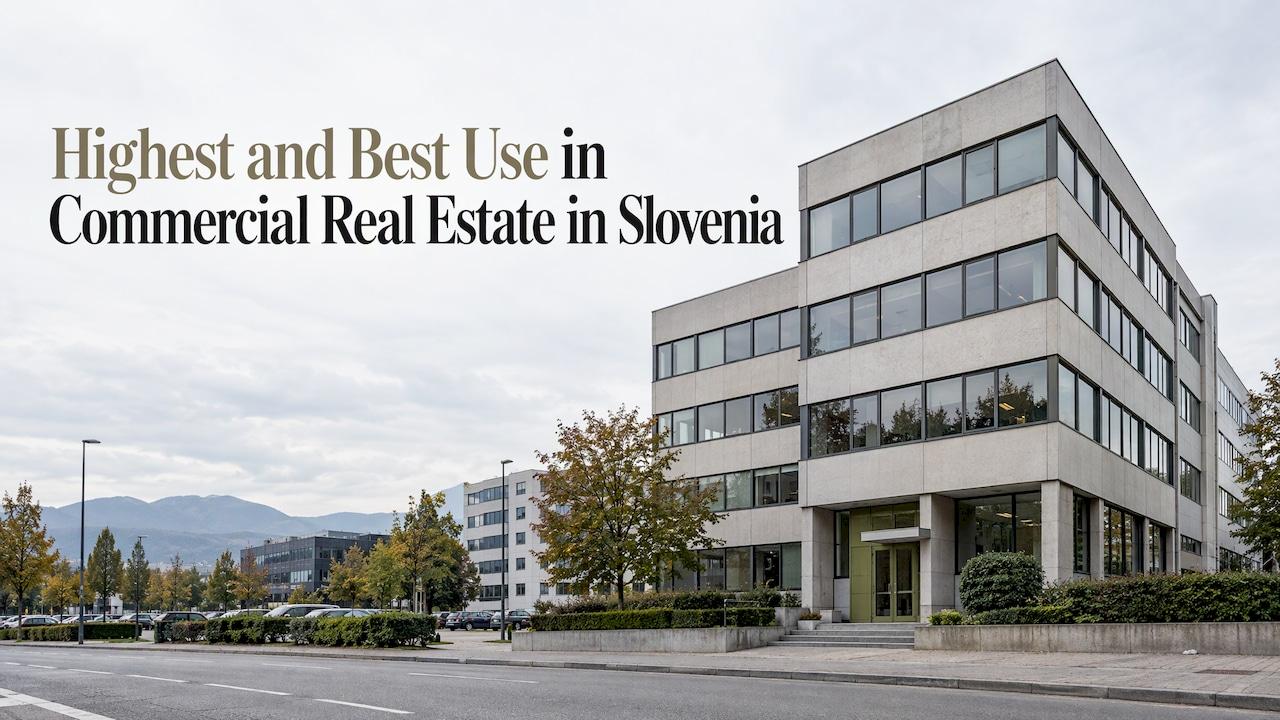
The market has moved since. Vilharia in Ljubljana, with more than 36,000 m² of office and retail space, was pre-certified LEED Platinum by its developer, with an ambition to add LEED Zero Carbon. The project is presented as suited to companies looking for premises aligned with ESG principles and the EU taxonomy. That tells you who asks for labels: companies with group-level sustainability reporting, usually international, and the investors who buy such buildings.
The same page cites benefits for LEED buildings against standard offices: 40% lower heating and cooling energy, up to 30% less water and 20% lower CO₂. Treat these as the developer's reference figures, and compare them with the actual utility bills of any building you are assessing.
How to choose: five questions
- Who is your end user? If your likely tenants are North American or global corporates, ask which label their real estate policy names. If your buyers are European funds, BREEAM is often the familiar language.
- Is the building new or existing? New builds can plan for either from the start. For existing stock, compare BREEAM In-Use with LEED for operations and maintenance, and check what condition the building is in. A facility condition assessment shows which systems stand between you and a rating.
- What do your lenders or investors require? Some funds specify a label or a minimum level in their mandate. Read the document before you pick.
- What can the building realistically earn? Aim for the level you can reach with the planned works. A Gold or Excellent that you actually reach is worth more than a Platinum you abandon halfway.
- What will it cost to run? Fees are small. Plan the capital works, and the running-cost data you need to keep the certificate credible.
If the answer to question one is "we do not know yet", that is a market question, not a certification question. Understanding who is actually looking for space in your submarket comes first, and it is the kind of work our market analysis and valuation covers.
For tenants: reading a green label in a lease
A tenant does not certify the base building, but can ask useful questions before signing:
- Which scheme and level does the building hold, and does it cover design only or operation as well?
- When was the certificate issued, and is it up to date?
- Who pays for service charges and any metering needed to keep it?
- Does the lease allow your fit-out to meet your own group's standards?
Our guide on what to look for when leasing commercial space covers the wider lease checklist, and a certificate is one line in it, not a replacement for it.
Where we help
We do not issue BREEAM or LEED certificates: that is the work of licensed assessors and the certification bodies. What we do is help you decide what the label should mean for your transaction. Our tenant representation covers search, analysis and negotiation of premises, so a company that needs a certified building, or simply a efficient one, gets its criteria written into the search. Owners who want to lease a building well can use our commercial space leasing for landlords, and investors can ask for investment advisory on how a building's sustainability profile affects the case. Owners with an operating building can also use our property management service, which is where the day-to-day performance of a building is looked after. You can start from our main page.

Our view
We do not think of BREEAM and LEED as a contest. We think of them as two languages that your future tenant or buyer may speak.
The first job is to learn which language they use. Many Slovenian owners start by asking which certificate is "better", and the better question is who will sign the lease or the purchase contract, and what their policy says. When we work with a landlord or a tenant, we begin with that: the user, the building, the market, the numbers.
The second job is to be honest about the building. A certificate is built on measured data and on documented work. Our boutique approach means one team follows a property from the first analysis to negotiation and closing, so the sustainability question is treated as part of the commercial one: rent, value, vacancy and long-term relationship.
The third job is to keep the long view. A building that performs well and is managed well keeps its tenants, and that is the outcome we plan for.
Maruša
FAQ
What is the highest LEED rating?
Platinum is the highest LEED level and needs 80 or more points after all prerequisites are met. Below it come Gold (60 to 79), Silver (50 to 59) and Certified (40 to 49). The nearest BREEAM equivalent in spirit is Outstanding, at 85% or more.
Is BREEAM or LEED better for an office in Slovenia?
Neither wins in every case. BREEAM is often preferred in Europe for its flexibility, while LEED is requested by many international occupiers and was the chosen label for Vilharia in Ljubljana. Choose the one your target tenant or investor names in its policy.
Do the two certificates measure the same things?
They overlap on energy, water, materials, waste and health, but weigh them differently. BREEAM adds broader topics such as ecology and pollution, and LEED puts more weight on energy and carbon. Ratings of the two cannot be converted one to one.
Can an existing building be certified?
Yes. BREEAM In-Use is designed for operating assets, and LEED has a rating system for operations and maintenance. Existing buildings are often the more realistic route in the Slovenian market.
How much does certification cost?
Registration and assessment fees run from the high hundreds to a few thousand in dollars or pounds per project, as in BREEAM's published US fees. The building works needed to reach the rating usually cost far more, so request a quote from an assessor for your specific building.
Sources
- LEED rating system, U.S. Green Building Council
- How Does BREEAM Work?, BREEAM
- BREEAM In-Use Standard
- BREEAM fees for USA and Canada projects
- LEED? BREEAM? WELL? Six Major Green Building Labels, Archinect
- Comparison of international environmental assessment methods, BRE
- Comparison of the certification systems for buildings, ICDLI
- Certification criteria and bio-inspired functional themes, PMC, 2026
- Sustainability rating and certification systems, 2025
- Comparative Assessment of LEED, BREEAM, and WELL, MDPI Energies, 2025
- Green Buildings Certifications, GlobalGBC
- Certificiranje stavb po načelih trajnostne gradnje pri nas, Zelena Slovenija
- Vilharia, the new benchmark of office spaces in Slovenia, Odprte hiše Slovenije